Interview with Richard Povall, Executive Editor, art.earth "On a day like today we just need to look forward"
"art.earth always relied on a warm spirit of generosity in its work which was absolutely reciprocal.
It has always been our job to support and nurture artists in their work.
But in like manner we have always felt supported by others."
Richard Povall, executive editor of earth.art Books, was interviewed by Geoff Davis in July 2026.
art.earth Books is the publishing imprint of art.earth, an organisation recognised for bringing together the voices of artists, scientists, foresters, philosophers, policy-makers, who would not otherwise share the same room.
Although art.earth's programme of international symposia closed in 2023, the imprint continues, publishing work that grows from that research and from the conversations it generated.
Its particular interest is in how the arts speak to the world, and how artists and practitioners from other disciplines can inform one another. Many of the artists they publish address questions of environment and the natural world. The books reflect that, combining academic rigour with artist journals, gallery documentation and provocation.
By invitation, art.earth Books also publishes work from outside the organisation, where it shares a clear affinity with the imprint's ethos and mission.
Editors: Dr Richard Povall (art.earth Books), Chloë Uden (Regen and Art & Energy Collective).
art.earth describes itself as bringing together voices who would otherwise never speak to one another. In practice, what does that mean? Who are the voices that most need to be in the same room right now around energy and creative practice?
Art is often seen as irrelevant to most people's lives and in some cases this is probably, if I'm honest, true. A lot of contemporary art can seem frivolous, a bit like it's taking the piss out of an audience that 'doesn't understand'. Actually, sometimes it is. The artists we work with and the art I've always tried to nurture is not like this. We invite artists who make art that speak to, and about the world around us to come together, to share their work and their reasons for making it. This work addresses real-world problems, or at least, speaks to real-world problems - in our case the challenges to our climate and our planet and our species.
But even then, art is not necessarily seen or understood as something that can make a real contribution to society. It is often called on as 'window dressing', for sure, or as a means of helping to communicate an idea or a set of facts. But it's rarely seen as a real contribution to knowledge or as a game-changer. The best art does both of these things.
So I've always tried to bring art to people - usually by not placing it within the white walls of a gallery but instead to bring it out into the open, into public spaces, into parks, gardens and even open spaces.
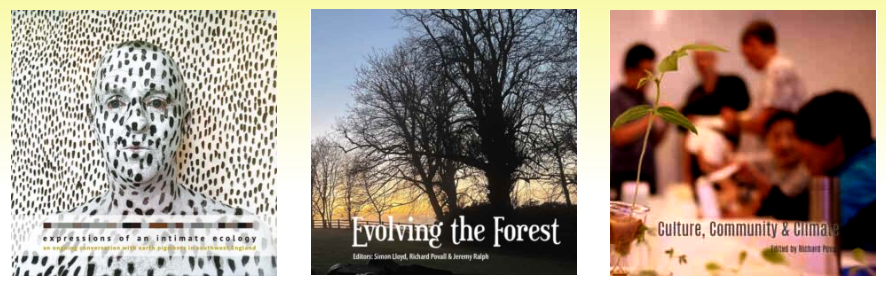
art.earth is playing a slightly different role: we are not commissioning art or supporting artists to make work, but instead we are trying to share the importance and relevance of art to the most pressing contemporary issues. We can only do this by persuading scientists, engineers, policy-makers, academics and thinkers and many other professionals that artists are serious people proposing serious answers to serious questions. And we can only do that by bringing them into the same room. As an example, our Evolving the Forest event - an international symposium and a subsequent publication - brought artists together with geographers and foresters and policy makers and philosophers, etc. A forester who makes their livelihood harvesting trees was listening to an artist or poet talk about sentience in trees, that trees are living beings. The artist, in turn, was listening to and talking to someone who understand that trees are also for harvesting and that these cyclical processes also brought advantage to the planet and its ecosystems. This is a conversation that simply would not normally happen.
We are no longer doing events, but our publications (as art.earth Books) host a space for the sharing of a range of opinions you would not normally encounter within the covers of a single book.
The new publication focuses on energy, culture and creativity. Digital art is often positioned as environmentally light compared to physical art — no materials, no transport, no gallery heating. Is that assumption still credible?
I question whether this is a valid assumption. In what way, I wonder, can digital art be seen as 'environmentally lighter' than physical art. The vast majority of physical art has a relatively light carbon footprint. Yes, there are monumental pieces that require vast amounts of energy and machinery to make and install just as there are large-scale digital art pieces that require significant resources, but most of what we think about as 'art' (by which I think you mean visual art) is made by hand, uses traditional materials or materials derived from traditional materials, requires no power to operate and quite often relatively little power to make. So in what sense, I wonder, is this environmentally heavier than a piece of digital art (we could argue for pages about what that phrase actually means, but let's assume we are talking about art that can only exist within a digital device)?
Digital art requires the relatively heavy carbon burden of its tools to create and requires power to operate. It is usually designed to run on a particular device or platform that will become obsolete in the not distant future. If designed as a web-based offer, then it is utilising the carbon-intensive resources that go to make up the internet. And don't even get me started about AI…
Artists like Refik Anadol make large-scale AI-driven immersive works and claim environmental awareness as part of their practice. How do you square that with the enormous and growing energy cost of the AI systems powering those works?
This work is largely outside my sphere of knowledge. But you can ask the same questions and make the same arguments about the carbon cost of artists who must travel to make their livings. Most artists travel quite a lot and when they do it's almost inevitably by flying. Now of course there are those who don't do this but it's a challenging calculus for many who need to be able to travel between continents (and even across continents) to see and be seen. If an artist who is making work about climate change, let's say, overspends their carbon allotment by five or more return transatlantic flights every year, then have they negated their work? My honest answer to this is that I don't know - it can only be up to the individual to rationalise how they balance their carbon cost with their potential carbon contribution.
So, in the case of an artist whose work relies on significant power resources in order to produce it and to run it (each and every day) then only that individual can make a case to rationalise those two competing elements in their life. Sometimes that calculus can be measure by the impact of the work, but not always. As an example, the BBC's Planet Earth series used a lot of tech, a lot of power and many thousands of miles of air travel to make happen. Its carbon footprint was heavy. But its impact at the time was huge - it can be argued that the vast reduction in the use of single-use plastic was significantly attributable to this series of films.
I choose not to fly, but I don't actually need to in order to continue my work.
Carbon offsets were widely adopted by the creative sector as a response to environmental concern, but are increasingly seen as greenwashing. Do you think the arts world has moved on from that, or is it still using offsets as a way of avoiding harder questions?
Personally I think carbon offsetting should always have been seen as greenwashing. Like CCS (carbon capture and storage) it was and remains a lazy, careless 'solution' to a problem that actually requires radical and fundamental change. My answer to your question largely depends on what you mean by the 'arts world'. I think conventional theatre, for example, is still very much dominated by questions of 'sustainable practice' (which may indeed involve carbon offsetting) rather than fundamentally changing the way they operate in order to cut their use of power and carbon resources. That said, the tools that theatre uses to create the illusion that is so fundamental to their practice have changed quite radically. LED lighting, for example, is now used as a direct replacement for traditional stage lighting which was incredibly power hungry. But these are by-products of an evolving technology rather than any fundamental commitment to changing the world by changing their way of operating.
There is a view that the energy is used anyway — that offsetting or claiming green credentials does not actually change the underlying consumption. How do you respond to that argument?
I agree with it entirely. I see little by way of radical change in those parts of the sector that are energy hungry. But please bear in mind my earlier answers - that most of what we think of as visual art is not at all energy hungry to begin with and is inherently 'sustainable'. I do hate that word, by the way - it is as odious and meaningless as 'net zero'.
NFTs had a moment of intense scrutiny over their energy use, then that conversation seemed to fade as the market collapsed. Has the underlying problem been solved, or just forgotten?
NFT's energy problem was never really the issue. NFTs were brought to the market merely to make money from nothing. NFTs faded because they fundamentally misunderstood what most people want when they purchase a work of art: something original, bearing the hand of the maker and which has some meaning to them. Of course there is an 'art market' that is interested merely in the value of a piece of art, and that is the world where NFTs initially thrived. NFTs were nothing more than cynical vaporware as far as I'm concerned, and anathema to 95% of living artists and 95% of people who buy or appreciate art. Now, let's talk about cryptocurrencies…
The computer industry as a whole is accelerationist — more devices, more data centres, more AI training runs, more everything. Can individual artists or publishers meaningfully resist that, or is the embedded energy of digital practice now unavoidable?
No, artists who use digital tools in their practice almost certainly cannot resist that. If you rely on a computer or other digital device to make your work, you are inevitably caught up in that accelerationism because it is impossible to resist. At some point, it just becomes impossible to use a 10-yr old computer, although it was not that many years ago that it was almost impossible to use a three-year old computer. So in some sense this acceleration is slowing, at least.
I have a distinct memory of being at a computer music conference in the 1980s where a composer was bemoaning the fact that his entire oeuvre was being wiped out because his University was disposing of all its Cobol computers (well, it may have been some other language, but you get my point). So here was an artist who used digital means to create their work and was attempting to resist change - and he was by no means unique. There were many composers and other artists using digital tools whose work became essentially obsolete. That's a hiding to nowhere.
So, as I mentioned earlier, individual artists have to make their own rationales. Environmentalists, or those who believe we have a climate emergency, are not luddites. We all have to make accommodations to the modern world simply in order to live. I choose to live rurally and many will argue that brings with it a higher carbon footprint than those who live in the middle of a city. That may be arguable, but it is an argument I have to have with myself in order to continue to live this way.
art.earth is interested in narrative and exploration rather than definitive solutions. Is there a risk that arts-led conversations about energy become a way of aestheticising a crisis rather than responding to it?
There are no definitive solutions: if there were we would not be in the pickle we currently find ourselves in. All we can do is ask more questions because all 'definitive solutions' are doomed to failure. You could equally argue that scientists and (ok, perhaps to a lesser extent) engineers are more interested in narrative and exploration than in solutions. Because without the former there are no solutions. And any solution we come up with will always be trumped by the next round of narrative and exploration.
So, yes I believe artists are there primarily to ask questions and to provoke responses from others in asking those questions. Some do this rudely, even violently (not my style) while others do so with subtlety and poetics - but the role of the artist is always as provocateur. So are we 'aestheticising a crisis' - no, I don't believe so. I'm not sure it is even possible to do this. If you acknowledge there is a real crisis (still the fundamental problem in this entire issue) then you can either draw attention to it (perhaps beautifully) or you can propose solutions to it (which may be equally beautiful). But you don't prettify it or soften it by doing so.
Your publication invites independent international voices. Are there regions or communities whose relationship to energy and creativity you think are currently underrepresented in these conversations?
Of course. The same communities who are underrepresented in everything else. Can we address that? We can but try.
You mention tinkerers, activists, engineers and scientists alongside artists. What does an artist bring to the energy conversation that those other voices cannot?
Artists, in general, are all of those things, or synthesise the skillsets that go to make up those things. Most artists I know are, at heart, problem solvers. To make their work they often begin with a problem (even if the problem is: how do I best represent this tree) and then they work and work and work to find a solution to that problem. Some artists address the same problem for their entire working lives, and simply get better at expressing solutions (while never actually finding one); others begin a new project with a whole new set of problems to work through. And that's what all these other people do. So what can artists bring that these other voices cannot? Well, the honest answer is probably nothing with a large 'but'. Artists are good at making you look twice - and that's the difference, perhaps. It may be the job of an engineer to solve a problem, it may be the job of a scientist to prove a hypothesis, it may be the job of an activist to fight for what they believe in, but artists do all this by continuing to pose questions, by making you pause even if just for a moment, to think differently.
So, in answer to your question, I would hope, always, that a powerful piece of art will make you stop and ask a question of yourself. Or at least to say, huh…really?
The Anthropocene
Many researchers place the start of the Anthropocene at 1610, when Antarctic ice cores record the Orbis spike, an atmospheric carbon anomaly corresponding directly to the Great Dying of the Americas, in which up to 90% of indigenous populations perished through introduced disease, slavery and warfare following European colonisation. As the jungle regrew over depopulated land, carbon dropped. The data makes the genocide visible in the atmosphere. (This also connects to what some call green fascism, the idea that population reduction, rather than consumption, is the root cause of ecological collapse.)
An intersectional analysis argues that colonialism, not simply industrialisation or capitalism, is the origin of the climate crisis, and that advanced communist economies were equally extractive. If so, incremental adjustments to this global extractive culture will make no difference, as the record of climate conferences suggests: each generates its own embedded energy, while solutions such as electric vehicles shift rather than reduce consumption and decarbonise the problem rather than address it.
How does this structural analysis sit with art.earth's campaigning?
This question makes some very fundamental assumptions and calls some existential challenges and I certainly don't have the expertise to question those assumptions. It seems to suggest that however much we tinker we will not mitigate the underlying causes of climate change. I disagree with this, and anyone who believes that human action can mitigate the effects of climate change will I'm sure feel the same. It's absolutely correct to say that unless we make major societal change that challenges the underlying extractive culture this crisis will not diminish - and we are in fact going entirely in the opposite direction at the moment. Let's face the fact that we are not going to stop climate change, whatever we do. The IPCC said that unless we hold global temperature increase below 1.5°C then we are headed for a genuine disaster. We have already exceeded that limit (in 2024 global temperature rise was 1.6°C above pre-industrial levels according to ECMWF).
Does this mean we just give up? Well, that's one answer but it's not one I can sign up to. You cite EVs (I drive one) as one example. It's true to say that EVs require extracted minerals, etc. to be built, together with large amounts of energy. (Incidentally, the first EV using sodium battery technology is now on the market, which means the biggest offender - the car's battery - is now primarily using a mineral that is available in vast quantities, and, crucially, is renewable.) Once the car is built, however, and as long as you are charging it with energy from renewable sources, then your extractive footprint is significantly less than an ICE vehicle, and you are not further polluting the air each and every mile you drive.
So, I have to believe that each individual action has to make a contribution, however small, however infinitesimal, to addressing the problems we face. It is the job of the artists we work with to attempt to share some kind of message, to make people stop even if just for a moment and take pause, to use emotional rather than technical language. I don't consider this campaigning - our job as a publisher is to help others to understand the role of the arts in all this. But I have to believe that this work can make a difference - otherwise it is simply navel gazing.
Given that digital art depends on computers, themselves developed for warfare, with early computer art dismissed by collectors as mathematical formulae displayed on repurposed military hardware, is there a contradiction at the heart of environmentally engaged digital practice? The current AI arms race has clear parallels with that history. And yet the modern world, including any resistance to it, runs on the internet. Agitprop on a MacBook. Any comment?
If we buy that argument, then we should reject pretty much everything that sustains us in this technological age because it can be attributed to military roots. We have the silicon chip because of the moon landings, and we had the moon landings so that America could prove it was superior to the Soviet Union (demonstrably better than dropping nuclear bombs on each other I would suggest). If we refused to use any device whose history is from military research then we would have a very diminished world. Humans like to kill one another, and in order to do so have created all kinds of wondrous and infernal machines that ultimately we all benefit from. The internet itself only exists because of early research at DARPA - should we not use it for that reason? You could equally argue that pretty much all Western art and music only exists because of religion and was paid for by extremely wealthy individuals whose wealth came from exploiting others and, often, making war on others. For me, religion is as toxic as any militia (and in many cases, synonymous). So sorry, for me, this is a non-argument.
Note
The Computer Arts Society is supported by the British Computer Society BCS. Their Climate policy states that they actively promote the technology industry's transition to a sustainable future. Their core policy recommendations include:
Green Tech Advocacy: Supporting investments in renewable energy infrastructure, smart grids, and the modernisation of energy-hungry data centres.
Data Transparency: Working with special interest groups (such as the BCS Data Management group) to establish greenhouse gas tracking and robust carbon reduction frameworks across all business sectors.