
Edward Ihnatowicz
Edward Ihnatowicz
Early CAS
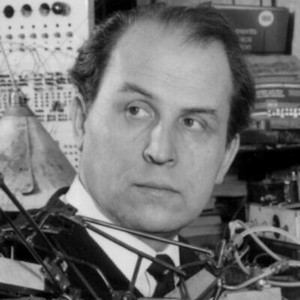
Edward Ihnatowicz was a pioneering cybernetic sculptor whose work explored relationships between machines, people and their surroundings. Active in the computer arts community, he combined artistic invention with engineering to create sculptures that responded to audiences rather than simply moving through predetermined sequences. His Sound Activated Mobile, known as SAM, appeared in Cybernetic Serendipity at London’s Institute of Contemporary Arts in 1968. Using hydraulics and sound feedback, it established ideas that he developed in the Senster, a large robotic sculpture commissioned by Philips for its Evoluon exhibition centre in Eindhoven. Sound and movement sensors enabled the work to react to visitors.
Working with the robotics team at University College London, Ihnatowicz brought sculpture, computer programming and mechanical design together in the Senster. Its responsive behaviour demonstrated that computer art could extend beyond prints and animation into physical encounters between artworks and audiences. His practice also encompassed the Bandit and later computer graphics. Within the Computer Arts Society’s history, his work exemplifies the meeting of artistic and technical knowledge. He introduced Dominic Boreham to John Lansdown and CAS, helping connect another practitioner with the Society. Subsequent CAS talks have examined his sculptures, ideas about artificial intelligence and embodiment, and their preservation.
AI Generated from CAS Sources