The Computer Arts Society remembers Sarah Mallen (1941–2026)
Catherine Mason
Sarah Ann Mallen (née Graves) was a good and supportive friend to the Computer Arts Society (CAS) and its members from the earliest days. This short tribute is written from the point of view of her relationship with CAS.
Sarah studied Physics at the University of Brighton; it was here that she met George Mallen, also a Physics undergraduate, who later became one of the founders of CAS, along with Alan Sutcliffe and John Lansdown. After graduating in Physics, Sarah went on to be a researcher at Farnborough Royal Aircraft Establishment (RAE), as did George. The demands of World War II saw an escalation in innovations at the RAE, including the development of the gyro gun sight, axial flow jet engine and rocket launch tests. Here Sarah was involved, in a hands-on capacity, with building the first Gallium Arsenide Laser in the world, a high-efficiency semiconductor diode laser commonly used in fibre-optic communications.
According to the artist, and friend of the Mallens, Stephen Willats, Sarah "had a bright and chirpy nature. She was a perfect counterpoint to George who was unassuming, logical and a bit of a geek!" Described as a great partner to George, it appears that Sarah helped with George's relationship to Gordon Pask, when he worked at System Research in the mid-1960s. Pask, who ran the British cybernetic 'think-tank' System Research, was known to be idiosyncratic and eccentric. Artist and friend, Brian Reffin Smith, found that, "as with George, she enjoyed alternative and non-establishment ways of seeing things, and encouraged and initiated connections and flights of thought that might have seemed to some others too outlandish, risky or ironic." They were a strong unit and were frequently seen at events together.
Sarah understood what a truly radical development it was to combine art with computing and digital simulation. She became a great supporter of George's work, and then of course of CAS, from 1969 when Event One, CAS's first major exhibition took place, at the Royal College of Art (RCA). Like Dorothy Lansdown, Sarah regularly helped behind the scenes assisting with CAS exhibitions and activities.
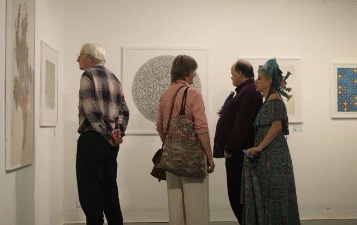
Sarah Mallen (centre) with Sean Clark (right) and George Mallen (left) at CAS Exhibition Event Two, Royal College of Art, 2019
When the family moved to London in the early 1970s, Sarah started working part time while raising three sons, Conroy, Wayland and Jason. As an editor for John Murray publishers, she quickly rose up the ranks and was poached by Addison-Wesley (AW) to lead their scientific and academic publishing arm. This brought her physics and natural business acumen together. Under her leadership the AW group expanded and became a leader in that field. Multiple foundation books were published across the academic spectrum including computer science, biology and economics. This job took her to prominent academic authors throughout Europe and the USA, and she enjoyed an executive jet set life during the 1980s. At a time when personal computing, enterprise software and the internet were nascent ideas, she quickly realised the central role that 'content' would play.
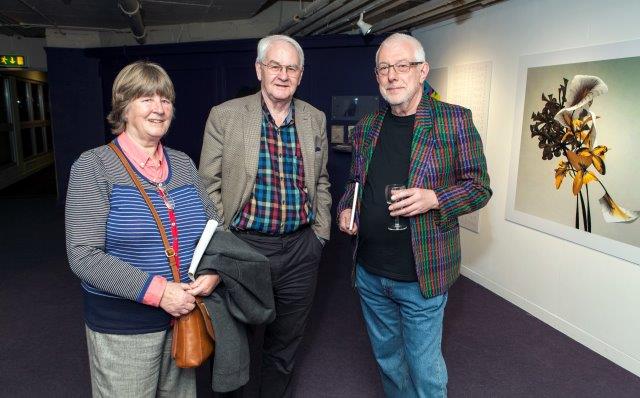
Sarah Mallen (far left) with George Mallen and Paul Brown, at the opening of the Brown and Son exhibition at Watermans Art Centre, London 2015. Photo © Oliver King.
Meanwhile George was setting up his company System Simulation Limited (SSL), with Mike Elstob. SSL developed into a computer graphics application business with a specialisation in museums collection management. Sarah's skills in publishing and business development were a perfect match, as both Sarah and George knew that SSL needed stronger marketing and business talent, which she had, and indeed she doubled the company's earnings and income within a few years, helping lead SSL through a decade of strong growth. It became one of the longest running software companies in the UK. One of the first projects undertaken by SSL was Ecogame, a collaborative project led by George that involved many CAS members. Ecogame was a simulation model of an economic system and the UK's first computer-controlled interactive 'game', exhibited 1970 in London and 1971 in Davos.
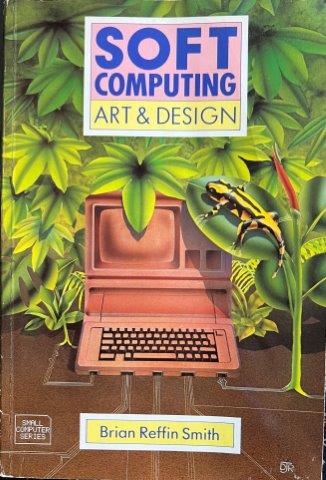
Among Sarah's projects at AW was the commissioning of Smith's book Soft Computing: Art and Design (1984), one of the first books that recounted the story of how CAS was founded. Smith recalls, "She of course made suggestions and was very helpful, but basically left me the freedom to write in perhaps strange ways, that maybe helped it to become a bit of a cult book." Sarah told me that the cover design, instigated by her, was inspired by Ecogame. The image shows a desktop computer 'plugged into' green foliage, nature, the 'soft' part of computing, representing the qualitative area of art and design. The book includes interviews with George, John Lansdown, the cybernetic sculptor and CAS member Edward Ihnatowicz, and others.
At AW Sarah also recalled making a teaching video with the computer scientist and famous artificial intelligence pioneer Donald Michie, who had worked at Bletchley Park, which she said was "quite an experience!"
She knew how to talk to artists. She cheered people on in Edinburgh during CAS's second big exhibition Interact: Machine, Man, Society in 1973. Willats recalls her help with some of the imaging for his Edinburgh Social Model Construction Project, commissioned by CAS and shown at Interact. Willats remembers her being "a serious part of this conversation. She was a visual person who saw the connection with George's interests and visual art. She had a good eye." Many in CAS enjoyed the conversations with different people from the computing world that she brought together over dinner at the Mallens' home in Twickenham. Sarah also supported artists by occasionally purchasing artwork. At a time when the art world in general shunned computer art, she collected work by CAS members including Willats, Smith, Paul Brown and others. She displayed this mini collection on the walls of their Twickenham home, and she did lend work to exhibitions.
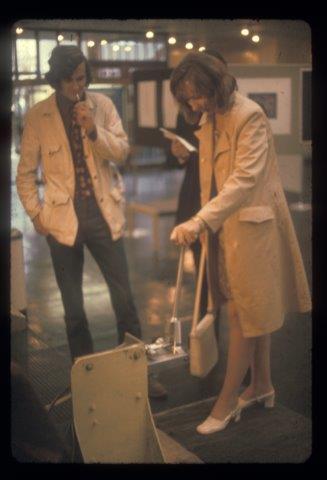
Sarah Mallen (right) interacts with Edward Ihnatowicz's The Bandit, whilst George Mallen looks on at CAS exhibition Interact, Edinburgh, 1973. Image George Mallen Archive. Reproduced with permission of Estate of Edward Ihnatowicz.
George took a Research Fellowship at the RCA, where he founded the Computing Activities Unit in the Department of Design Research and recruited Smith as the tutor of computing. Of that time, Smith remembers that he and Sarah "shared a certain distain for the sometimes bizarrely conservative views of those in power at the RCA in the early 1980s and their baleful effects on creative research. She sometimes spoke of their machinations with a certain wry detachment, though sadly aware of it all from George. She was a very warm and kind person."
Always practical and organised, Sarah helped to keep the CAS archive, held at SSL, that included ephemera as well as artworks shown in various CAS exhibitions over the years. This formed the basis for the CACHe project at Birkbeck University of London, which I joined in 2002, alongside Nick Lambert (a later Chair of CAS). It was immediately clear to us how enthusiastic she was about this history. This archive entered the Victoria & Albert Museum in 2007, as the CAS Collection, forming a strong core for the museum's (now extensive and highly regarded) digital art collection.
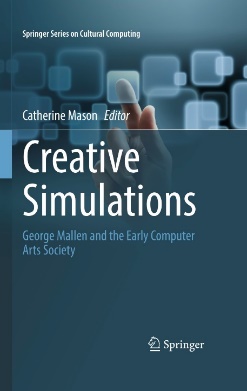
It was Sarah who instigated the book that became Creative Simulations: George Mallen and the early Computer Arts Society, edited by me and published by Springer in 2024, with contributions by Lambert and CAS Committee member Stephen Boyd Davis. Sarah continued to champion this project through several challenges over the number of years it took to write and produce. Sarah's memories of the early days of CAS, its artist members, and of course Ecogame, proved invaluable. One notable memory that made it into the book, was her story about how George spent many nights programming the code for Ecogame at home (1970). To do this he was connected, via teletype, to a time-sharing service, after office hours when it was less expensive. The teletype was so noisy that she had to cover it with blankets to deaden the sound, so as not to wake her children sleeping upstairs. True to form, Sarah also saved ephemera such as press clippings as well as the 35mm slides that formed the visuals of Ecogame. These materials are now in the Computer Arts Archive CIC in Leicester. She was able to attend the launch of this book at the EVA London conference in 2024, with family members.
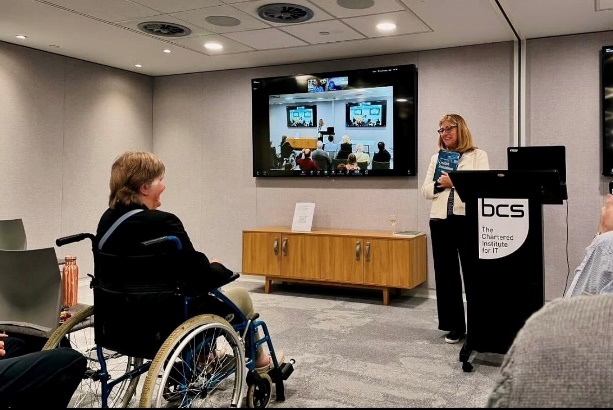
Sarah Mallen (left) attends Catherine Mason's book launch, at the EVA London conference, 2024
Only a few months before she died, she organised a trip to Tate Modern to see Electric Dreams, which featured work by Willats and other CAS members including Gustav Metzger and Tony Pritchett, pleased to see that this art had finally gained some mainstream artworld recognition.
Sarah Mallen is survived by her husband George Mallen and two sons, Wayland and Jason.