2025
-
10th December 2025
Computational Constructs
Sean Clark
-
19th November 2025
Why Are There So Many Great Women Artists in the Age of AI?
Anika Meie
-
15th October 2025
There Should Be No AI Art
Gary Hall
-
17th September 2025
Drivers Introduction
Stephen Bell
-
17th September 2025
My 50 Years in Digital Arts
Marcus West
-
25th June 2025
Klingemann & Iwamoto: AI Art
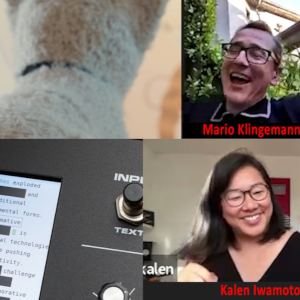
Mario Klingemann and Kalen Iwamoto
Geoff Davis introduces artists Mario Klingemann and Kalen Iwamoto for a Computer Arts Society discussion on AI, art and curation. He frames AI as a form of alien, non-human creativity that produces vast quantities of output, making curation central to artistic practice. Klingemann is known for Botto, an autonomous decentralised AI artist that both generates and selects works, including recent algorithmic art shown in London. Iwamoto presents text- and technology-based pieces, notably “The Writing on the Wall”, a series of future-dated gallery labels for unseen artworks that invite viewers to imagine the works themselves, reversing the usual human-machine roles by letting the audience supply the mental image. She also discusses her Miniscribe word-synth hardware and her use of AI as a linguistic sparring partner. The conversation touches on institutional critique, ownership and authorship in AI-generated art, the cultural and economic pressures of overproduction, contentious intellectual property debates, the broader threat of AI-related job losses across many sectors, and the risk that on-demand personalised media might reshape the very idea of art. Throughout, both artists treat AI not merely as a tool but as a collaborator and subject, exploring how machine creativity, human curation and audience imagination intersect.
-
21st May 2025
EZTV: A Case Study in Misunderstanding
Michael Masucci
-
24th April 2025
Transformations through Radical Art Practice
Bhavani Esapathi
In this Computer Arts Society talk, Anna Dumitriu introduces fellow artist Bhavani Esapathi, who reflects on what makes art radical through a practice rooted in disability, chronic illness and digital technology. Esapathi begins by questioning the term “radical” and presents a series of works that make invisible medical conditions visible. In “Inconclusive Diagnosis,” a life-size torso covered in scars invites viewers to ask normally taboo questions about her body. A later project with the Royal Wolverhampton NHS Trust and Wolverhampton School of Art examines stigma around inflammatory bowel disease and stomas in South Asian communities, using medical imagery and video to show what happens inside and outside the body. She also describes a collaboration with King’s College London neurobiologists studying psilocybin and neurons; rather than focus on the drug, she creates an audiovisual work about the care scientists give to cells and asks how that attention might transfer to patient consultations. Finally, she outlines an Oxfam project that uses digital storytelling with participants from Peru, the US, Colombia and elsewhere to build frameworks for understanding community needs. Throughout, Esapathi argues that art allows science and organisations to experiment with data, ask unconventional questions and create social change.
-
2nd April 2025
Listen, Scoundrels!
Sean Carroll
At a Computer Arts Society event titled *Listen, Scoundrels!*, Sean Clark introduces Sean Carroll, whose exhibition forms part of his PhD research at De Montfort University into the application of artificial intelligence to explore archival materials within the curatorial process. Carroll’s work examines the radical early history of the Computer Arts Society through an analysis of *PAGE* magazine, uncovering calls to action from figures such as Catherine Nash and Paul Brown that remain relevant to contemporary debates around technology, the art market, and artistic practice. Clark encourages the audience to consider what it means to be radical today and how the Computer Arts Society might foster critical, rather than dismissive, dialogue around emerging technologies such as AI and NFTs. Carroll explains that while archives often approach AI as a tool for efficiency and automation, his own background in exhibition making, participatory work, and artist development leads him to investigate the critical and creative applications of generative AI beyond mere automation. The event aims to spark ongoing discussion about how artists and curators can engage with technology critically, use it to enhance rather than replace human labour, and contribute to a revitalised Computer Arts Society.
-
21st January 2025
2026 Jasia Reichardt Lecture
William Latham
-
20th January 2025
Jasia Reichardt Lecture 2025
Francesca Franco
Sean Clark, chair of the Computer Arts Society, introduces the second annual Jasia Reichardt Lecture, welcoming Francesca Franco, a Venetian-born art historian and curator based in the United Kingdom and Italy. Franco, who holds a PhD in the history of art specialising in computer art, reflects on her long-standing connection with the Society and her curatorial work with pioneering generative artists including Vera Molnar, Ernest Edmunds, Manfred Mohr, Roman Verostko, and Frieder Nake. She dedicates the talk to Molnar, whose pioneering computer art has profoundly influenced her career, and discusses their collaboration on the Icon 2020 commission in Murano, Venice, which led to Molnar's historic debut at the Venice Biennale at the age of 97. Franco traces her journey from traditional Renaissance art history in Venice to digital art history at the University of London, highlighting her research fellowship at the Victoria and Albert Museum and her 2017 "Algorithmic Signs" exhibition in Venice. Throughout, she emphasises the importance of curatorial practice in making the complex histories of computational and generative art accessible to wider audiences, while documenting the voices and contributions of the field's pioneers.
2024
-
23rd December 2024
Electromechanical Drawing Machines

Jack Tait
Jack Tait presents his lifelong exploration of electromechanical drawing machines, explaining how simple instructions can produce complex, non-repeating drawings. He acknowledges key supporters, including Sean Clark, whose efforts have made the exhibition and event possible. Tait describes his programming process as a recipe of ingredients—forward and reverse motor behaviour, timing, and the natural speed variation of DC motors—which he turns to advantage to introduce quasi-randomness. He traces the development of his machines from early sine-wave and turntable devices through a homage to Desmond Paul Henry to recent work with flow pens and chisel-nib pens that vary line thickness. He also explains that colour draws viewers in, like bees to pollen, so they notice details they might otherwise miss. A central theme is his current obsession with randomness, chaos, and the persistence of coherence: he builds new machines to investigate specific visual questions, such as a six-contact randomiser mimicking a die and a linear-cam pen-rotation machine contrasting linear and nonlinear movement. Because the machines delegate decisions to mechanical chance, every drawing is unique. Tait also notes his shift from photographic paper and film to direct digital capture, ensuring his practice continues alongside the machines themselves.
-
24th November 2024
Peter Zinovieff and Electronic Music Studios
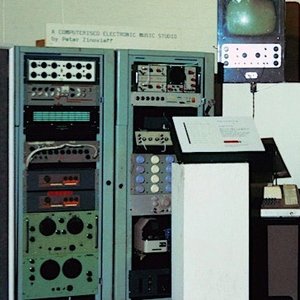
James Gardner
James Gardner delivers a Computer Arts Society talk on Peter Zinovieff and Electronic Music Studios, concentrating on Zinovieff’s early work and his collaboration with Alan Sutcliffe. He traces Zinovieff’s path from Oxford geology studies and tape-editing lessons with Daphne Oram to his Putney studio and the Unit Delta Plus partnership with Delia Derbyshire and Brian Hodgson. Gardner describes Mark Dowson’s stochastic tone generator, used at the 1966 Watermill Theatre concert—apparently the first all-electronic music concert in the UK—and explains how its unwieldiness led Zinovieff to acquire a PDP-8 minicomputer in 1967, famously financed by the sale of his wife’s tiara. David Cockerell built the interface between the computer and analogue sound equipment, while Tristram Cary and programmer Alan Sutcliffe joined the studio. Sutcliffe and Zinovieff used an ICT 1905 mainframe to generate compositional data on punched paper tape that the PDP-8 then realised through analogue devices. Gardner situates this work amid contemporary computer-music approaches, from algorithmic scores to the sound-synthesis programmes of Max Mathews, and notes Stanley Gill’s 1962 BBC commission as an important British precursor. Finally, he touches on the Synthi 100 synthesiser, linking it to the broader Electronic Music Studios story.
-
19th September 2024
George Mallen and the Early Computer Arts Society
Catherine Mason
Catherine Mason presents the early history of computer, interactive and generative art through the career of George Mallen and the founding of the Computer Arts Society. Drawing on her book *Creative Simulations*, she explains that Mallen, a physics graduate who worked at the Royal Aircraft Establishment, joins Gordon Pask’s cybernetic think tank, Systems Research, in the mid-1960s. There he learns how digital simulation can model thought processes and serve the public good. In 1968 Mallen co-founds the Computer Arts Society with Alan Sutcliffe and John Lansdown, following the IFIP conference in Edinburgh and the influence of *Cybernetic Serendipity* and experiments in art and technology. Around 1971 he establishes System Simulation Limited, a software firm that supports museums and cultural organisations and safeguards the Society’s large collection of plotter drawings and prints, later donated to the Victoria and Albert Museum in 2007. Mason highlights Gordon Pask’s conversation theory and the *Colloquy of Mobiles* installation as key inspirations, showing how cybernetic ideas about communication, control and machine learning shape Mallen’s technological optimism and creative practice.
-
29th August 2024
Unreliable Past
Lev Manovich
Lev Manovich describes his return to making single images after fifteen years of “cultural analytics,” a shift that comes from the emotional shock of Russia’s 2022 invasion of Ukraine and from feeling that he loses the country a second time, decades after leaving it. He regards generative AI not as a passive tool but as a formidable, unpredictable collaborator whose statistical training compresses data into frequent patterns, inevitably favouring clichés and stereotypes when asked to imagine unfamiliar subjects. To resist this, he uses ambiguous prompts and reference images; in the series “After the Long War,” he instead embraces the clichés—Russian churches and Kremlin architecture—that models like Midjourney automatically insert into images of Moscow. By placing these symbols in ruined, post-war visions of Russia in 2028 or 2032, he turns the medium’s tendency towards stereotype into a dystopian meditation on destruction, historical unreliability, and cultural loss. He also observes how AI can simulate handwriting and grammar in non-existent languages, evoking the fragility of memory and the many unrealised ideas that vanish from human history. For Manovich, working with AI becomes both an adversarial struggle and a way to process grief.
-
28th August 2024
CAS Members Show 2024 Opening
Various Speakers
Various Speakers open the Computer Arts Society’s 2024 members’ show at the BCS, describing it as the organisation’s second annual open-call exhibition. The event has grown from twenty works chosen from twenty-five applicants the previous year to twenty-nine selected from more than sixty this year, and the chair hopes future editions will include 3D, video and time-based work alongside the current 2D focus. The exhibition aims to capture the contemporary zeitgeist of digital and computer art, presenting pieces that range from traditional generative and algorithmic imagery to generative AI, hand-made work, image manipulation and artist-developed techniques. The speakers demonstrate the society’s website and a new ISBN-registered catalogue, available as a free PDF and in a limited print run, which includes additional works that cannot be shown in the physical space. They briefly survey selected pieces and artists before inviting those present, and online viewers, to look at the installation, consult the catalogue and chat informally with the artists over wine.
-
19th August 2024
Research Workshop Pop-Up Show at EVA
Various Speakers
In this presentation, Various Speakers from the School of Visual Arts' MFA Computer Arts programme introduce their department's philosophy, curriculum, and international collaborations. They describe a two-year terminal degree with around one hundred graduate students, roughly seventy-five per cent international and seventy per cent women, working across 2D and 3D animation, storytelling, and experimental practices including game design, artificial intelligence, augmented and virtual reality, real-time rendering, haptic surfaces, and projection mapping. The speakers emphasise collaboration, creative industries, and real-world production experience, drawing on backgrounds in high-end visual effects, game design, and feature animation. They note the department's nine Student Academy Award winners and its Visible Futures Lab, which offers access to advanced fabrication technologies. They highlight partnerships with European institutions, student volunteerism at conferences such as EVA, VIEW, FMX, and SIGGRAPH, and innovative projects with acclaimed filmmakers. They also address artificial intelligence as the latest technological disruption, comparing it to historical shifts in photography and digital design, and argue that it requires an artist driver. They encourage students to embrace these tools, since graduates will compete with people using AI rather than lose jobs to the technology itself.
-
1st August 2024
Lumen Prize Evening Artists In Conversation at EVA
Various Speakers
Various Speakers trace the evolution of the Lumen Prize and the practice of computational art. The founder recounts the prize’s origins in the idea of celebrating digital art and notes that it has rapidly outgrown her original expectation that winners will simply produce flat, auctionable prints; instead, it has embraced 3D, interactive, augmented reality and other complex forms. She notes the prize’s international growth, its long connection with the Computer Arts Society, and announces an exciting new London studio space, made possible by partners. A computational artist and mathematician then reflects on winning the Gold Award a decade earlier, calling the prize a continuing source of opportunities that has led to exhibitions in venues such as the V&A and ZKM. He presents his generative works, which simulate biological growth processes inspired by figures such as Alan Turing, and explains how tiny rule changes yield cellular structures, plant-like growth, hybrid creatures and 3D-printable sculptures. He treats computational systems as unruly artistic materials, shaped by constraints such as fabrication overhangs rather than forced into conventional engineering. Together, the speakers emphasise that digital art has a long history and that the most compelling work emerges at the intersection of art, science and technology.
-
18th July 2024
Chinese Social Evening at EVA
Various Speakers
At the Computer Arts Society’s Chinese Social Evening at EVA London, the speakers celebrate a day dedicated to strengthening ties with China. The opening remarks highlight that EVA London has built closer links with the East than with the United States, and that Chinese creative thinking emphasises human engagement and Eastern inward transcendence across Confucianism, Buddhism and Taoism, in contrast to a more technology-driven American approach. A contributor notes that building the metaverse is ultimately about people’s needs, not simply technology. Sean Clark and his Guangdong University of Technology colleague then introduce the university’s School of Art and Design, showing a short video and student projects that use AI-generated content and coding tools. They acknowledge both the creative power of AI and the nervousness around assessment and proper pedagogical use, stressing the importance of cultural understanding alongside technical skill. Sean Clark describes his hybrid teaching model, combining short visits to China with remote delivery from the UK, and previews work on digital objects made physically manifest. The evening concludes with a performative lecture by an exhibiting artist, followed by informal conversation and wine.
-
10th July 2024
Book Launch Evening at EVA
Various Speakers
-
19th April 2024
Unearthing Digital Tendencies in Post-War Texts in Print
Bronac Ferran
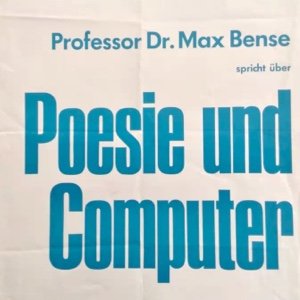
Bronac Ferran explores how post-war printed texts anticipate digital, binary and nonlinear modes of composition and reading. She traces the influence of information theory and early computing on experimental poetry, beginning with Max Bense’s 1965 account of “agentive aesthetics,” in which creative control shifts from the human author to a constellation of programmed, generative procedures. Drawing on Claude Shannon’s statistical methods and his own frequency analyses of literary works, Bense argues for computer-programmed artificial poetry and, by 1959, encourages students to use the Zuse 22 mainframe to produce algorithmic texts. Ferran highlights Theo Lutz’s stochastic text, generated from a lexicon and syntactical rules, alongside Helmut Heissenbüttel’s visually patterned “Vortex” poem, showing how both works make sequence, spacing and repetition meaningful in themselves and foreground how punctuation, intervals and visual arrangement become carriers of meaning. She also invokes Alan Turing’s insistence that the property of being digital matters more than being electronic, and Gregory Bateson’s definition of digital signals as discontinuous, reinforcing the idea that digitality is a notational rather than medium-specific quality. Through these examples, Ferran unearths a pre-digital field of human–machine language experimentation rooted in post-war print culture.
-
4th April 2024
Algorithmic Photography
Alex May
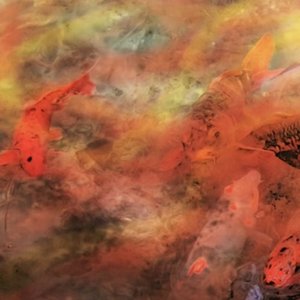
In this Computer Arts Society talk, artist Alex May introduces algorithmic photography as a contemporary extension of chronophotography. He begins with Eadweard Muybridge’s 1878 motion studies of a galloping horse and the parallel chronophotographic gun of Étienne-Jules Marey, observing that technology has long been used to extend human perception beyond its natural limits. May presents it as both an aesthetic exploration and a potential research tool, echoing Muybridge’s utilitarian origins while insisting on the human-scale, sensory value of extended vision. He explains that, unlike conventional long-exposure photography, his algorithmic process lets him decide per pixel which elements from thousands of video frames are retained or discarded, producing images such as seagulls hovering over Brighton Pier or hornets infesting a Maltese beehive. He traces his artistic lineage through stop-motion animation, experimental film, and early home computing, citing influences from Willis O’Brien and Ray Harryhausen to Maya Deren, Andrei Tarkovsky, David Lynch, and Godfrey Reggio’s Koyaanisqatsi, as well as the Sinclair ZX81 and Commodore Amiga that redirected him toward programming. He connects this practice to his current fellowship at the University of Surrey, where he responds to quantum biology, arguing that technology reveals hidden workings of existence while also expanding embodied experience.
-
19th March 2024
Analogue Drawing Machines
Jack Tait and Sean Clark
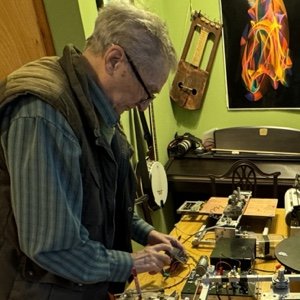
In this Computer Arts Society talk, artist Jack Tait and curator Sean Clark discuss Tait’s analogue drawing machines in a conversational format alongside an exhibition at Phoenix. Clark leads Tait through his motivations, and Tait begins by thanking supporters—including the Computer Arts Society and the Science Museum—who helped publish, exhibit and collect his work, noting the importance of advocates in promoting art. He recounts how his interest started in the 1950s while serving in the RAF, where radar research involving oscilloscope image conversion inspired his later light-based work. In 1960, after seeing a harmonograph demonstration at art college, he builds his first machine from Meccano, replacing pendulums with programmable cranks and pulleys to create precise yet organic line growth. He explains that the machines are deterministic—governed by physical ratios and Cartesian coordinates—but tiny starting differences ensure every drawing is unique, echoing Alan Turing’s observations on generative systems. In the 1970s, Tait applies engineering skills to more accurate light-drawing machines and pays homage to fellow pioneer Desmond Paul Henry by reverse-engineering Henry’s wartime analogue-computer-based spherograph. Throughout, Tait and Clark explore the philosophy of delegating artistic control to a machine, embracing unexpected outcomes and asking whether machine-made marks qualify as art.
-
24th February 2024
AI Creative Writing and Art
Geoff Davis, Ana Cabellero, Patrick Lichty, James Bloom and Johnny Dean
Geoff Davis introduces a Computer Arts Society talk marking the launch of the second edition of the AI Creative Writing and Art anthology, a free collection featuring around 30 to 40 artists. He notes rapid advances in AI over the past year, including sophisticated text generators, OpenAI’s Sora text-to-video model and Google’s Gemini 1.5 with its large context window, and observes that AI art is now appearing in mainstream galleries and museums, while the NFT market faces oversupply. He also discusses the Writers Guild of America strike agreement, which treats AI as a tool rather than an author, and warns that co-creation language can undermine artists’ control. Davis then introduces the evening’s artists: Ana Cabellero, Patrick Lichty, James Bloom and Johnny Dean. Cabellero describes herself as a literary artist and poet, explains her belief in web3’s potential for writers, and outlines The Verse Verse, a gallery that pairs poets with digital artists. She discusses its Gen Text series, which brings together poets, artists and AI writing tools, and begins to present a collaborative work made with the AI artist Iona, rooted in personal experiences of grief.
-
19th February 2024
Peter Hardie Exhibition Opening
Stephen Bell
Stephen Bell opens the Peter Hardie exhibition at the BCS Moorgate offices on behalf of the Computer Arts Society, explaining that the show runs until roughly September and that visitors can book via the society’s website, while the catalogue and a video show reel are also available online. Bell then presents an overview of his friend and colleague Peter Hardie, whose practice from 2004 to 2019 involved modelling and animating virtual scenes in the 3D animation system Softimage XSI rather than using 2D paint systems. Hardie renders scenes with a virtual camera, often compositing layers to produce a distinctive painterly style informed by Monet, Riley and Bonnard, transforming observed moments in landscape—light on water, reflections, sparkles on the sea, waterfalls—into quiet, non-narrative, contemplative animations. Bell notes that Hardie studied photographs and locations, then abstracted their essential qualities through painstaking technical work, collaborating with others such as Andy Hayes on shaders. The talk screens these animations in thematic order, tracing exhibitions at Bridport Arts Centre, SIGGRAPH in Los Angeles, New Greenham Arts and elsewhere, and invites the audience to experience the work as they would a painting.
2023
-
16th December 2023
The Quantel Paintbox
Adrian Wilson, Kim Mannes-Abbott and Cesare Massarenti
-
4th December 2023
Talk: Post Internet Curation: Online Art Ecologies of the Web 2.0 Era
Pita Arreola-Burns and Elliott Burns
Pita Arreola-Burns and Elliott Burns examine the architectonic and curatorial characteristics of online galleries that emerge during the Web 2.0 era, a period often described as post-internet. They situate their own platform, offsite project, founded in 2017, within a wider ecology of online curatorial spaces that support new-media artists and address techno-social themes, encompassing downloadable zip shows, a Google Maps residency, offline exhibitions and a writing practice, as part of an ongoing, non-definitive research project. Drawing on Marisa Olson’s 2008 coining of “post-internet,” they trace a community of surf-club practices that sample, remix and circulate digital imagery. To illuminate online exhibition design, they compare the dense, hierarchical hanging of the Royal Academy Summer Exhibition and the Paris Salon with the contained frame of the laptop screen and browser window: both construct a central coordinate and a navigable field, even if the body moves differently in each. They argue that post-internet aesthetics flow from online to offline alongside a countercurrent of curatorial properties that hybridise exhibition design, and that this lineage continues into three-dimensional metaverse spaces and Web3 curation. The talk frames these online galleries as generative sites for folding histories against one another and rethinking curatorial space in the 2020s.
-
26th October 2023
The ZKM Digital Art Collection
Morgan Stricot and Beatrice Zaidenbery
In this Computer Arts Society talk, Morgan Stricot and Beatrice Zaidenbery from ZKM | Center for Art and Media in Karlsruhe outline the museum’s digital art collection and the challenges of conserving and exhibiting software-based works. Stricot explains that ZKM holds around 12,000 works, including roughly 1,000 digital pieces and about 200 software-based artworks, which demand disproportionate conservation resources. She highlights key works from the 1990s onward—such as laserdisc-driven interactive installations, SGI-based virtual environments, touch- and body-tracking pieces, and speech-recognition works—showing how artists have repurposed consumer and specialist technologies. She also notes efforts to improve the representation of women artists through recent acquisitions and restoration loans. Zaidenbery then introduces the curatorial perspective, describing how recent exhibitions, including *BioMedia* and the late Peter Weibel’s *Renaissance 3.0*, shape the selection and presentation of artworks. Together, the speakers demonstrate how preservation concerns influence ZKM’s collection concept, research projects and international outreach, and they stress the continuous maintenance required to keep complex digital installations accessible in a rapidly changing technological environment.
-
28th September 2023
The Aleph Null Projects

Jim Andrews
In "The Aleph Null Projects," Jim Andrews presents his ongoing work on Aleph Null, a graphic synthesizer and instrument of colour music that he has developed since 2011. He explains that colour music is a centuries-old concept in which visuals proceed through time with colours, shapes, and forms rather than sound. Aleph Null operates on a painterly metaphor: users create brushes that sample from folders of images and draw successive brushstrokes across the screen at least once per frame. Version 1.0 functions purely as an instrument of colour music, while later versions introduce bitmap processing capabilities. Andrews describes the project's origins in DB Cinema, an earlier graphic synthesizer he built as a poetry performance tool, and recounts how a Canada Council grant prompted him to retool from Director to HTML5 canvas. He situates his practice between visual art, electronic literature, and audio art, noting that his work has become increasingly visual over time. Throughout the talk, he shares screenshots and live demonstrations of Aleph Null's configurable controls, including opacity, frames per second, and polygon size, while reflecting on his interdisciplinary background in English, mathematics, radio production, and computer science.
-
3rd June 2023
Talk: AI and Images
Geoff Davis, Luba Elliott, Patrick Ehtesabian-Lichty et al.
In this Computer Arts Society talk, Geoff Davis introduces a panel on AI and images, with Luba Elliott set to trace AI art from 2015 to the present and Patrick Ehtesabian-Lichty to discuss a post-human AI exhibition. Davis notes the recent media alarm over AI safety and the longer history of debates around superintelligence, bias and ethics, while observing that artists address these issues variously. He argues that the more immediate, everyday risks may be physical and mental: sedentary posture, eye strain and the isolation that David Byrne and others link to technology. Against doomsday narratives, Davis highlights the joy many creatives feel on first using text and image generators, and distinguishes AI systems that mimic human output from earlier generative art that produces algorithmic abstractions. He surveys AI art tools from Harold Cohen’s turtle-drawn AARON to the popular but controversial Ada robot, and notes how cheap, accessible generators are now embedded in mainstream software such as Photoshop. This ease of production brings choice anxiety and a flood of imagery, yet also opens possibilities for outsider art and online communities, leaving AI art in an ambiguous, partly separate relation to the traditional gallery system.
-
26th May 2023
How Quantel's Paintbox Changed Our World
Adrian Wilson and Kim Mannes-Abbott
Adrian Wilson and Kim Mannes-Abbott present a talk arguing that Quantel’s Paintbox, rather than Photoshop, pioneers electronic image manipulation. Wilson, a photographer and curator, explains that the Paintbox—launched in 1981 as a video tool and refined into a photo-quality system by 1985—predates Adobe and establishes many techniques now associated with Photoshop. He describes a Computer Arts Society exhibition he curates, first at Phoenix and later at the BCS in London, which showcases around twenty works demonstrating the device’s capabilities. Mannes-Abbott, an original Paintbox employee and artist, joins to offer first-hand insight. Wilson recounts how early Paintbox output, recently rediscovered in attics and archives, reveals forgotten contributions by major artists and designers, including work for advertisements, film posters, and album covers. He also traces Quantel’s origins in broadcast video synchronisation and notes that Paul Keller’s technical breakthrough solves the problem of jagged lines, making real-time digital painting possible. Together, they make the case that the Paintbox deserves far greater recognition as a foundational technology in computer art and design.
-
1st May 2023
AI and Text Generation
Geoff Davis et al.
In this Computer Arts Society talk on AI and Text Generation, chaired by Sean Clark and hosted by the BCS, Geoff Davis et al. survey the rapid emergence of AI text generators and their creative possibilities, noting an upcoming AI and image talk. Davis, an AI and tech researcher at the University of the Arts London Creative Computing Institute, founder of Micro Arts and director of Story Software, outlines how tools such as ChatGPT have moved from older rule-based expert systems and the novel-writing project Brutus to today’s neural nets trained on massive internet data, enabling idea generation, collaborative writing, editing, visual storytelling, personalised content, adaptive gaming narratives, and cross-disciplinary collaboration. He shows his own early procedural story generator, Mark Webster’s sentiment-analysis-based text art, and Sasha Styles’s AI language-glyph works, while acknowledging Harold Cohen’s pioneering generative system AARON. Davis also presents his AI Creative Writing Anthology, which includes Brian Reffin Smith, and introduces the invited speakers—Devon Rice, Real C, Maria Cecilia Reyes, and Shuwon—who cover environmental literacy, reformulated poetry, narrative influence, co-writing fiction and poetry, and AI text in education. The talk frames current debates around technology, ethics, artificial general intelligence, and the practical, gallery-ready potential of machine-generated writing.
-
30th March 2023
History of AI in the Arts
Paul Brown, Ernest Edmonds, Stephen Bell and Catherine Mason
In this Computer Arts Society talk, Catherine Mason chairs a discussion on the history of artificial intelligence in the arts, arguing that today’s rapid, corporate-driven advances in tools such as ChatGPT and image generators raise urgent questions about consent, copyright and regulation that the arts are well placed to address. The session focuses on pioneering work of the 1970s at the Slade School and Leicester Polytechnic, where artists and programmers begin writing their own algorithms and exploring rule-based, generative and interactive systems. Mason introduces early precedents including the Computer Arts Society’s first exhibition, Event One, Robin Shirley’s 1968 poetry program Bard, and the Slade’s experimental department shaped by Malcolm Hughes, Harold and Bernard Cohen, and Julian Sullivan, whose and-cam system helps artists preserve ephemeral screen-based work. Ernest Edmonds then describes the cross-disciplinary projects he instigates at Leicester Polytechnic, where amalgamated art and technology faculties encourage collaborative experimentation. Finally, Paul Brown and Stephen Bell reflect on the Slade artists’ interest in cellular automata, artificial life and self-generating processes, showing how these 1970s innovators anticipate many of the conceptual and practical concerns now animating debates about AI and creativity.
-
22nd February 2023
CAS Open Evening
Sean Clark et al.
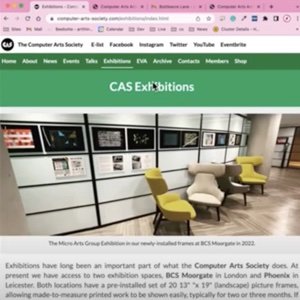
At the CAS Open Evening, Sean Clark and fellow committee members introduce themselves and outline the society’s recent and future activities. Paul Brown, joining from Australia, describes his forthcoming 56-year retrospective at the BCS foyer; Stephen Bell discusses his early computer-art work and interest in behavioural animation and education; and Graeme mentions his role co-chairing the EVA London conference and his research into long-term preservation of digital photographs. Sean Clark then presents the refreshed CAS website and explains the society’s affiliation with BCS, which provides London exhibition space. He highlights Ernest Edmonds’s current show at BCS Moorgate, plans to tour it to Leicester, and a signed limited-edition print sale to raise archive funds. He previews a packed exhibition programme: Jeff Davis’s Micro Arts, Paul Brown’s retrospective, a members’ show during EVA London, a Sue Gollifer retrospective, a women-in-digital-art exhibition, Adrian’s Quantel Paintbox work, Leicester digital-art pioneers, and new generative work, with larger shows possible as resources grow. The aim is to build a national or international network of venues so shows can tour, invite members to host exhibitions, encourage wider participation in computer art, and capture CAS history from 2004 to the present through archival and related digital preservation projects.
2022
-
7th November 2022
Luciana Haill - Apparitions & Pioneer AR
Luciana Haill
-
30th April 2022
Leicester Computer Arts History
Sean Clark et al.
Sean Clark introduces a Computer Arts Society archive project that documents the history of digital art in Leicester and Leicestershire, an area in the centre of England with a high density of arts-focused institutions including Loughborough University, Leicester Polytechnic and De Montfort University. He explains that the project builds on the Computer Arts Society archive, adding materials from the mid-2000s onwards, and mentions related collections such as the Micro Arts works by Jeff Davis and the CAS50 collection. Clark describes a recent exhibition at Beta RX, a community art space on Churchgate in Leicester, featuring work by Ernest Edmonds, Stephen Scrivener, Stephen Bell and himself, and notes plans for future exhibitions and a catalogue. He then introduces Ernest Edmonds, who recalls arriving in Leicester in the early 1960s to study mathematics at Leicester University, moving into computer science at Leicester Technical College, and beginning to explore the use of computers in art in the late 1960s alongside Stroud Cornock at Leicester Polytechnic. Edmonds explains how this early interdisciplinary work influenced both his artistic practice and the direction of computer science, and he shares a relief piece from that period as an example of his early computer-related artwork.
2021
-
20th December 2021
Four Decades of the Quantel Paintbox
Adrian Wilson et al.
In this Computer Arts Society Christmas lecture marking the fortieth anniversary of the Quantel Paintbox, Adrian Wilson and his fellow speakers celebrate the machine that revolutionises 1980s television graphics. Wilson opens with archive footage demonstrating the Paintbox’s pressure-sensitive pen, which produces a remarkably naturalistic, brush-like line and luminous digital colour that David Hockney and Howard Hodgkin recognise as a genuinely new medium. The system enables broadcasters to create weather maps, title sequences and pop-video post-production far beyond the earlier Letraset and cardboard methods. Because it costs hundreds of thousands of pounds and requires a refrigerated suite, it is initially treated as engineering equipment in unionised television stations, so engineers rather than artists operate it, resulting in grids and simple geometric imagery. Eventually, independent design studios purchase Paintboxes and hire artists, and networks such as MTV follow, giving designers round-the-clock access. One contributor recounts his journey from art school to the late shift at MTV, where he produces daily news graphics and animated interstitials. The talk concludes that the Paintbox not only defines the bright, digital aesthetic of the decade but also establishes the creative foundations for the image-making software and hardware that people now take for granted.
2020
-
2nd June 2020
The Computer Arts Archive
Sean Clark
Sean Clark introduces the Computer Arts Archive and traces the history of the Computer Arts Society, which is established in 1968 following the Cybernetic Serendipity exhibition and soon becomes a specialist group of the British Computer Society. He explains that the original society publishes the PAGE bulletin and organises events until it ceases in 1985, after which a research project at Birkbeck College in the early 2000s leads to the society’s re-establishment in 2004. A 2010 programme of events at the Victoria and Albert Museum marks the culmination of much preservation work, with many early materials now held by the V&A. Clark, who becomes involved around 2008 and takes over the website in 2012, describes how he digitises and shares the society’s early and contemporary output. He shows the archive section of the website, highlighting the complete run of PAGE magazines, articles by founding members, early documents, and images from the V&A collection and other material that supports teaching and research. He also notes the Computer Arts Society YouTube channel, where collected videos are shared. Throughout, he stresses the importance of preserving the history of computer arts while continuing to support new generations of artists.
-
28th May 2020
Elephants Don't Love Peanuts But Humans Do
boredomresearch
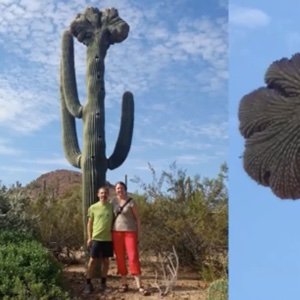
In this Computer Arts Society talk, boredomresearch presents an overview of their twenty-year collaborative practice, which embeds artistic inquiry within scientific laboratories to explore environmental, biomedical and technological questions. They describe residencies with swarm-robotics researchers in Austria, where the resulting artwork “Robots in Distress” expresses ideas of vulnerability and agility rather than pure robustness. They also discuss cross-disciplinary workshops with animation students and a commission with the University of the West of Scotland that reimagines the Jacquard loom as a generative engine producing unique biological forms, reflecting on creative diversity lost to industrial mass production. A project with an Oxford neuroscientist translates the neural activity of sleeping mice into visual form, while recent work at the Biodesign Institute in Arizona examines cancer through evolutionary and ecological lenses. The talk’s title alludes to Peto’s paradox: elephants, despite having far more cells than humans, experience lower cancer rates because they carry multiple copies of the tumour-suppressor protein p53, a finding unrelated to peanuts. The collective explains how scientists there look to nature’s catalogue—including comb jellies, flatworms and simple organisms such as Trichoplax—to discover new model systems and defence strategies against cancer, inviting audiences to reconsider relationships between humans, animals and biomedical science.
-
20th May 2020
Microworld@Home
Genetic Moo
At this Computer Arts Society talk, the host introduces Genetic Moo as long-standing associates of the Computer Arts Society, the London Group, and the Lumen Prize, before the artists outline their collaborative practice and the forthcoming Microworld@Home project. Genetic Moo describe how their work draws inspiration from biology, microorganisms, and artificial life, creating interactive digital creatures from manipulated human and synthetic source material that respond to audience behaviour through webcams, microphones, and touch screens. Their signature Microworld installations function as connected digital ecosystems in which individual artworks feed off and react to one another as well as to visitors, encouraging unencumbered, multi-user engagement. They recount previous iterations of the project, including community coding workshops in Bracken, a robust modular installation at Eureka, and a large-scale 355-square-metre exhibition in Saudi Arabia featuring eleven interconnected works. They also announce a two-hour live online performance for the following Saturday at 8 p.m. UK time, presented as a Computer Arts Society social event combining Zoom chat with a YouTube live stream. The talk concludes with a brief question-and-answer session about the technical scale of Microworld installations, with the smallest version typically requiring four computers.
-
12th May 2020
Deep Learning as a Creative Collaborator, Or How I Learned to Stop Worrying and Love AI
Andy Lomas
-
28th April 2020
Network Art In A Lockdown Time
Ernest Edmonds
-
22nd April 2020
'Luminations' Light Installation
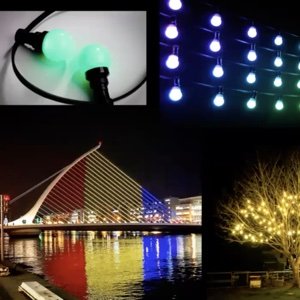
Esther Rolinson
-
14th April 2020
Edward Ihnatowicz: SAM, The Senster, The Bandit And Other Works
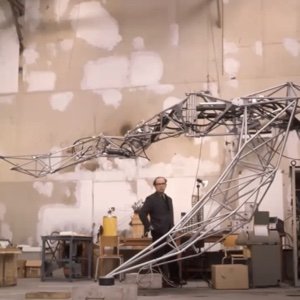
Alex Zivanovic
-
7th April 2020
A Mirror For Remembering
Alex May
-
19th January 2020
In The Dark 2 Genetic Moo
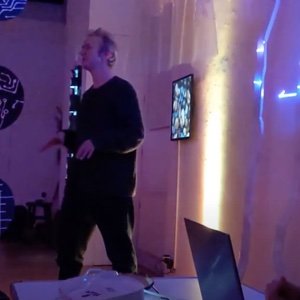
-
19th January 2020
In The Dark 2 - Oliver Gingrich
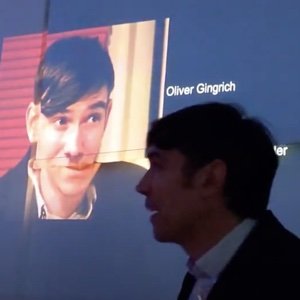
-
19th January 2020
In The Dark 2 - Aphra Shemza
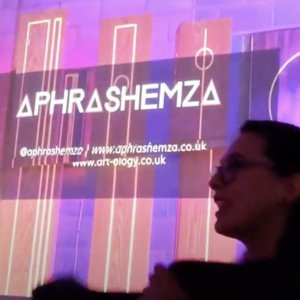
-
19th January 2020
In The Dark 2 - Andy Lomas
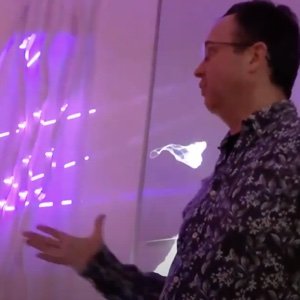
-
19th January 2020
In The Dark 2 Sean Clark
-
19th January 2020
In The Dark 2 - Introducing CAS
-
19th January 2020
In The Dark 2 - Ernest Edmonds