In The Dark 2 - Andy Lomas
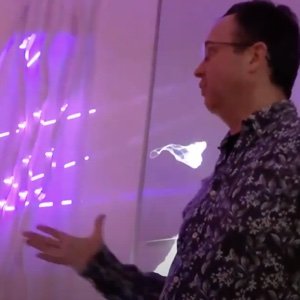 Title: In The Dark 2 - Andy Lomas
Date: 19th January 2020
Summary
Andy Lomas describes a practice in which computer code stands in for chemicals, allowing him to simulate the processes and relationships nature uses to generate living forms. He shows a three-dimensional animation of self-splitting virtual cells, explaining that he is less interested in pure scientific experiment than in remaining part of the creative feedback loop, selecting and directing outcomes rather than letting the system run randomly. He connects this to the theme of light and dark: life depends on steep gradients between bright, energetic regions and cold, dark ones, which drive the emergence of ordered structures within an otherwise disorderly universe. Using the analogy of water flowing down a slope, he argues that a gentle gradient produces predictable motion, whereas a steep gradient creates turbulence, feedback and rich complexity. His simulations work the same way: too little feedback yields a dull ball of cells, too much tears the system apart, but a precisely tuned gradient produces unexpected, beautiful behaviour. For Lomas, the interplay of light and dark is not merely a visual conceit but a deep principle underlying both biology and art.
Generated by AI using kimi-k2.7-code (2nd September 2026).