Unreliable Past
Lev Manovich
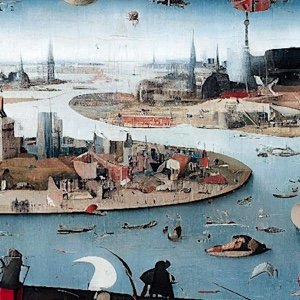 Title: Unreliable Past
Date: 29th August 2024
Speaker: Lev Manovich
Location: Zoom
Summary
In "Unreliable Past," Lev Manovich reflects on his return to making single images after years of developing cultural analytics, and on how generative artificial intelligence has reshaped his artistic practice. He explains that neural networks learn frequent patterns and ignore infrequent ones, which makes AI a powerful yet limiting medium prone to cliché and stereotype when asked to produce something genuinely new. Manovich discusses a series called "After the Long War," made in emotional response to Russia's 2022 invasion of Ukraine, in which he deliberately prompts visions of a ruined future Russia to subvert the Kremlin and church stereotypes that the model otherwise inserts. He also describes the "In the Garden" series, inspired by seventeenth- and eighteenth-century French formal gardens and old engravings, where the medium of fine linear etching becomes the world itself. Throughout, he argues that generative AI is less a passive tool than an active adversary with its own tendencies, and that its errors and version-specific artifacts can become unexpectedly meaningful. He ends by asking how art can recover a sense of history and purpose in a contemporary culture where, thanks to AI, almost any style is now instantly possible.
Generated by AI using kimi-k2.7-code (3rd September 2026).