Analogue Drawing Machines
Jack Tait and Sean Clark
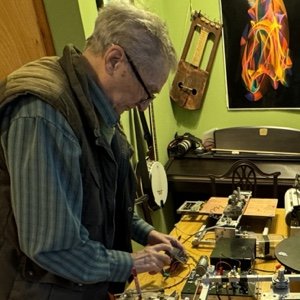 Title: Analogue Drawing Machines
Date: 19th March 2024
Speaker: Jack Tait and Sean Clark
Summary
Jack Tait traces his analogue drawing machines to 1950s RAF radar research and a 1960 harmonograph demonstration at Guildford Art College. His deterministic devices depend on precise mechanical relationships between X and Y coordinates—sometimes accurate to one part in a thousand—yet produce unique images because exact starting points cannot be reproduced, an idea he links to Alan Turing and the butterfly effect. Influenced by Desmond Paul Henry and the wartime analogue computers used in Lancaster bombers, Tait has built a menagerie of machines including sine-wave, turntable, drum and XY plotter devices, along with an analogue programmer that uses a rotary switch to control X, Y and pen movements. He regards the machines as sculptural objects, delegates creative control to them, then curates and often colourises selected drawings in Photoshop. The conversation explores determinism versus randomness, the transparent physical process, questions of machine and user authorship, and the democratic possibility of letting anyone produce an original artwork.
Generated by AI using kimi-k2.7-code (3rd September 2026).