The Recode Project
Mark Webster
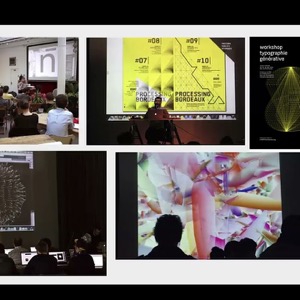 Title: The Recode Project
Date: 10th September 2026
Speaker: Mark Webster
Location: Zoom
Summary
Mark Webster introduces the Recode Project, a community-led initiative that brings pioneering computer artworks back into circulation by translating them into contemporary creative-coding languages. Drawing on his involvement with the project since 2012, he recounts workshops with artists including Bernard Demiau and Frieder Nake, and considers what is gained—and what cannot be preserved—when an artwork is reconstructed in new software.
The talk connects recoding to the history of generative art, from the Computer Arts Society's PAGE journal and the New Tendencies movement to Max Bense and Umberto Eco's idea of the “open work”. Webster argues that the value of recoding is not simply faithful replication: it is a way to study an artwork's rules, context and material conditions while opening it to new interpretations.
Webster also presents recoding as a teaching method. His graphic-design students analyse an existing artwork, recreate its structure in Processing, and then develop animated or interactive variations. The resulting code, books, websites and exhibition proposals turn historical research into an active creative practice. The discussion concludes with questions of authorship, conservation, obsolete technology, open-source knowledge and the role institutions and in-person communities can play in keeping computer art alive.
Generated by AI using kimi-k2.7-code (12th September 2026).